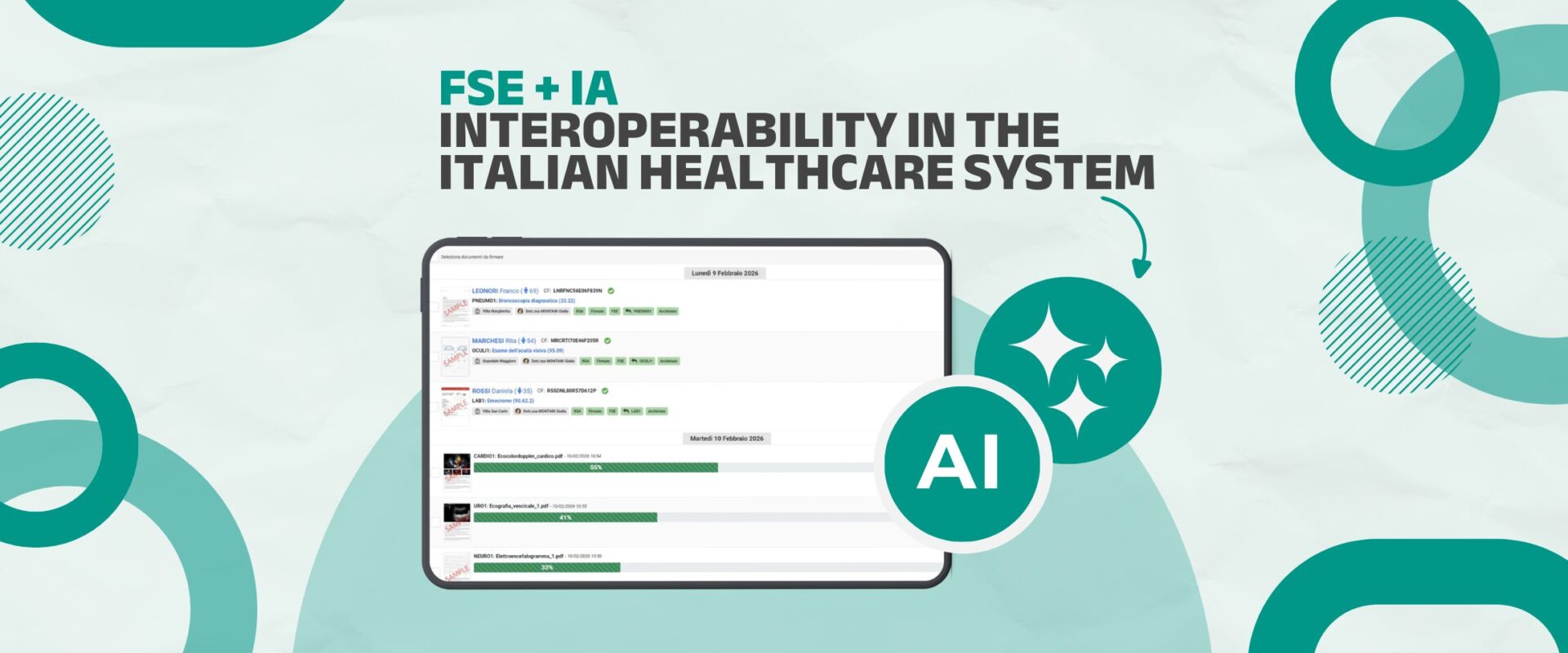
The Fascicolo Sanitario Elettronico (FSE) is the Italian digital system that centralizes citizens’ health information and allows authorized professionals to securely access clinical reports and other medical documents. While designed for the Italian healthcare system, it represents one of the most advanced European models for clinical interoperability. In this context, Connect Informatics develops AI-based solutions to simplify the structuring and submission of documents to the FSE.
Sending a Report to the FSE with a Single Click
In recent years, artificial intelligence has become one of the main drivers of technological innovation. From data management to cybersecurity and administrative process automation, AI is transforming the way organizations work and make decisions.
The healthcare sector is also benefiting from this transformation. While AI is often discussed in the context of diagnostics or clinical analysis, there is another area where its impact is equally significant: simplifying administrative and documentation processes.
Among these processes, one of the most complex is undoubtedly the submission of documents to the Fascicolo Sanitario Elettronico (FSE), the system that collects and makes citizens’ health information available digitally.
In this context, solutions have emerged that use AI to make the submission of reports to the FSE almost instantaneous, even when starting from unstructured documents.
From Report to FSE in a Few Steps
Traditionally, sending documents to the FSE required several technical and regulatory steps. Reports needed to be converted into standard formats, digitally signed, and accompanied by the metadata required by regulations.
In more advanced systems, documents must be generated according to specific standards, such as CDA2 (Clinical Document Architecture), and integrated into regional FSE workflows.
For healthcare facilities and software companies developing clinical management systems, this process can be complex and require significant technical integrations.
Today, artificial intelligence allows this process to be greatly simplified.
Through document recognition algorithms and content analysis, it is possible to automatically extract the key information from a PDF report, identifying elements such as:
- patient
- signing physician
- document type
- clinical content of the report
- tests or procedures performed
Once identified, the system automatically generates the metadata required by the FSE, constructs a standards-compliant document, and prepares it for submission.
The result is a very simple workflow: upload the report and send it to the FSE in just a few steps, without manually handling all technical aspects.
Zero Integration: AI Really Simplifies
One of the most innovative aspects of this approach is the ability to work without complex integrations with existing management software.
Many medical practices and outpatient centers still use office tools, like Word or report editors, to produce clinical documents. In these cases, direct integration with the FSE can be difficult or costly.
Thanks to AI, this limitation disappears.
The system directly analyzes the PDF generated by the healthcare organization, automatically recognizes its contents, and generates the metadata needed for submission to the FSE. This approach is called “Zero Integration”, as it allows working with the FSE even without complex application integrations.
In practice:
- The physician or facility generates the report as usual.
- The document is uploaded to the system.
- AI recognizes the data.
- The document is prepared for the FSE.
The result is a simple, fast, and regulation-compliant digital workflow.
Opportunities for Software Companies
This evolution does not affect only healthcare facilities.
Software companies developing applications for polyclinics, diagnostic centers, or medical offices face a dual challenge today:
- ensuring compliance with the FSE
- keeping software simple and easy to integrate
Platforms based on gateways and interoperable services address both needs.
On one hand, REST APIs can be used to integrate clinical software directly with the FSE submission system.
On the other hand, AI enables the processing of unstructured documents as well, expanding integration possibilities.
This allows a software company to offer full FSE compatibility without having to completely redesign its product.
Security and Regulatory Compliance
When handling health data, security and regulatory compliance are critical.
The most advanced platforms comply with major European and national requirements, including:
- GDPR, for personal data protection
- NIS2, for digital infrastructure security
- AI Act, the new European regulation on artificial intelligence
Additionally, security and quality standards, such as ISO 27001, ensure the safe management of health information.
Documents are processed using pseudonymized data, with change tracking and physician validation before final submission to the FSE.
This approach combines technological innovation with regulatory compliance, essential in digital healthcare.
A Complete Ecosystem for the FSE
Submitting documents to the FSE is not limited to clinical reports.
A complete system also manages:
- conversion to PDF/A
- creation of structured CDA2 documents
- physician’s electronic signature
- archiving and compliance storage
- document repository management
- integration with regional FSE systems
The most advanced platforms integrate all these elements into a single workflow, ensuring service availability and centralized process management.
A New Approach to Digital Healthcare
Adopting AI in healthcare administrative processes is a key step in digitalizing healthcare.
It is not only about introducing technology but also about rethinking workflows to make them simpler, more efficient, and interoperable.
AI-based solutions transform complex operations, such as submitting reports to the FSE, into fast and intuitive tasks.
For medical and diagnostic centers, this means simplifying IT management without compromising regulatory compliance.
For software companies, it means providing secure and rapid access to the FSE ecosystem.
Connect’s Ongoing Innovation
For more than twenty years, Connect has been developing software for the private and affiliated healthcare sector, supporting facilities and technology partners in digital transformation.
The introduction of AI-based solutions for submitting to the FSE is one of the new areas of innovation in which the company invests, anticipating sector needs and providing concrete tools to simplify healthcare interoperability.
In this context, using AI to send reports to the FSE is just one of many projects on which Connect is working to build the digital healthcare of tomorrow.