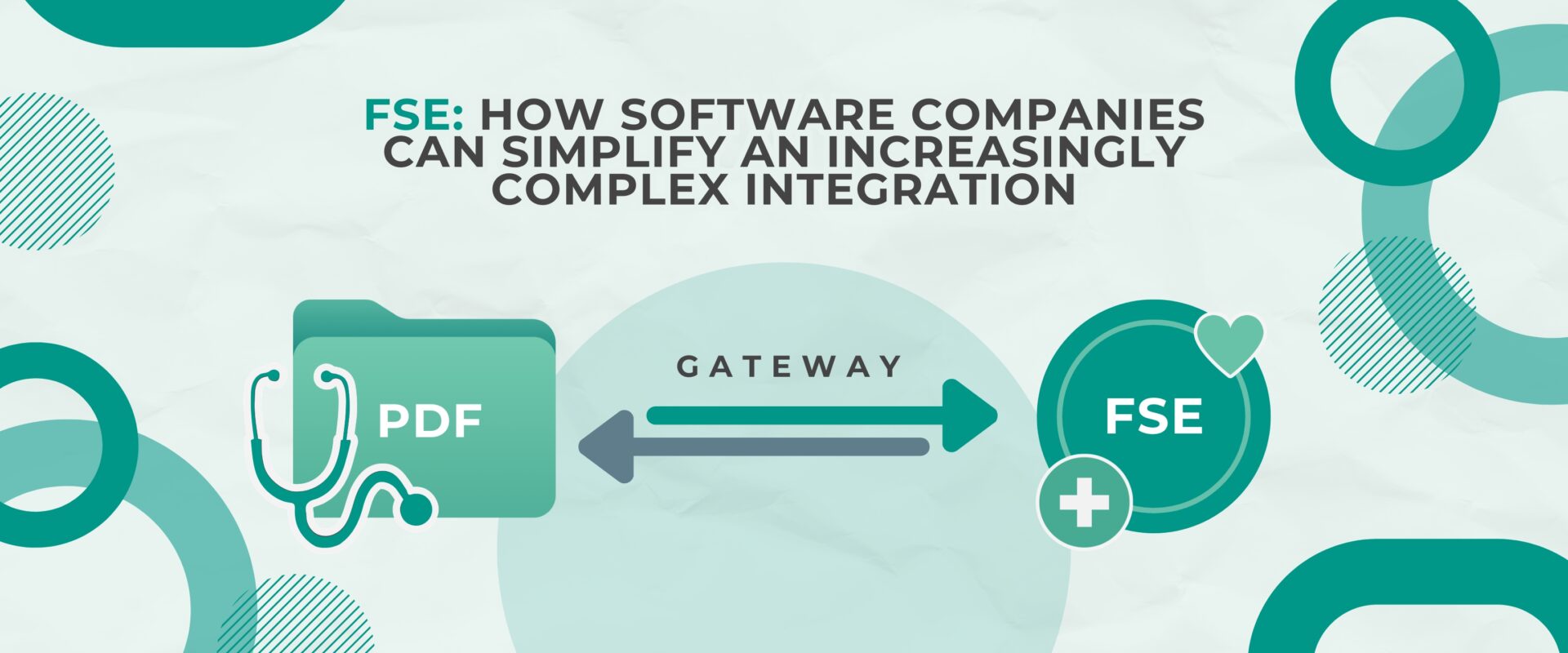
The Fascicolo Sanitario Elettronico (FSE) is the Italian digital system that centralizes and manages patients’ clinical information.
In today’s digital healthcare landscape, the FSE stands out as one of the most relevant — and at the same time most challenging — elements for software developers.
For software companies operating in outpatient settings, medical practice management, or more structured clinical environments, integrating with the FSE is no longer optional, but a necessary condition to remain competitive and compliant.
However, what is often underestimated is the true scope of this integration. It is not simply about “sending documents”, but about building — or integrating — a complex set of processes, rules, and standards that deeply impact software architecture.
Beyond document exchange: the real complexity of the FSE
When looking closely at the FSE, one key aspect quickly emerges: complexity is not concentrated in a single point, but distributed across the entire healthcare data lifecycle.
For example, a medical report cannot be treated as a simple file. It must be generated in a specific format, PDF/A, designed to ensure long-term readability, and at the same time structured according to the HL7 CDA2 standard, which enables formal and interoperable representation of clinical data.
On top of that, it must include a compliant digital signature, be part of a traceable and consistent workflow, and meet legal archiving requirements.
What emerges is a scenario where the clinical document becomes a complex object — not only technically, but also from a regulatory and procedural standpoint.
The real complication: regional fragmentation
The context becomes even more complex due to the distributed nature of the FSE.
There is no single centralized system, but multiple regional implementations, each with its own specifications, integration methods, and testing processes. This means that a solution developed for one region cannot be reused elsewhere without adaptations.
For software companies, this leads to an exponential increase in complexity. Each new integration requires time, expertise, and ongoing maintenance efforts, making the system progressively harder to manage.
When the FSE takes focus away from your core business
In this scenario, many software companies end up investing significant resources in building FSE-related components in-house.
While understandable, this approach brings clear medium-term consequences. Development teams become increasingly focused on regulatory and infrastructural aspects, while the core product — clinical features, user experience, and innovation — risks being deprioritized.
As a result, the FSE, originally designed as an interoperability enabler, ends up slowing down software evolution instead of supporting it.
A shift in perspective: decoupling complexity
The idea is simple — and we are the first in Italy to implement this approach: separating the management system from the integration and compliance logic of the FSE.
In this model, the software continues to handle clinical and operational processes, while all complex components — from document generation to digital signing and regional system integration — are delegated to a specialized external layer.
This separation reduces internal complexity, improves scalability, and makes the system more adaptable to regulatory changes.
Equipe FSE Gateway: a practical approach for software companies
This is exactly the context in which Equipe FSE Gateway was created — a solution designed to concretely simplify integration with the FSE.
The goal is not to add another technological layer, but to eliminate the need to develop and maintain complex components internally.
Through a REST API-based integration, the software can interact with the gateway in a simple and structured way. All compliance-related aspects are centrally managed: from generating compliant documents to digital signing, consent management, and transmission to regional systems.
This allows software companies to work with a clear and stable interface, delegating the most critical and evolving variables to the gateway.