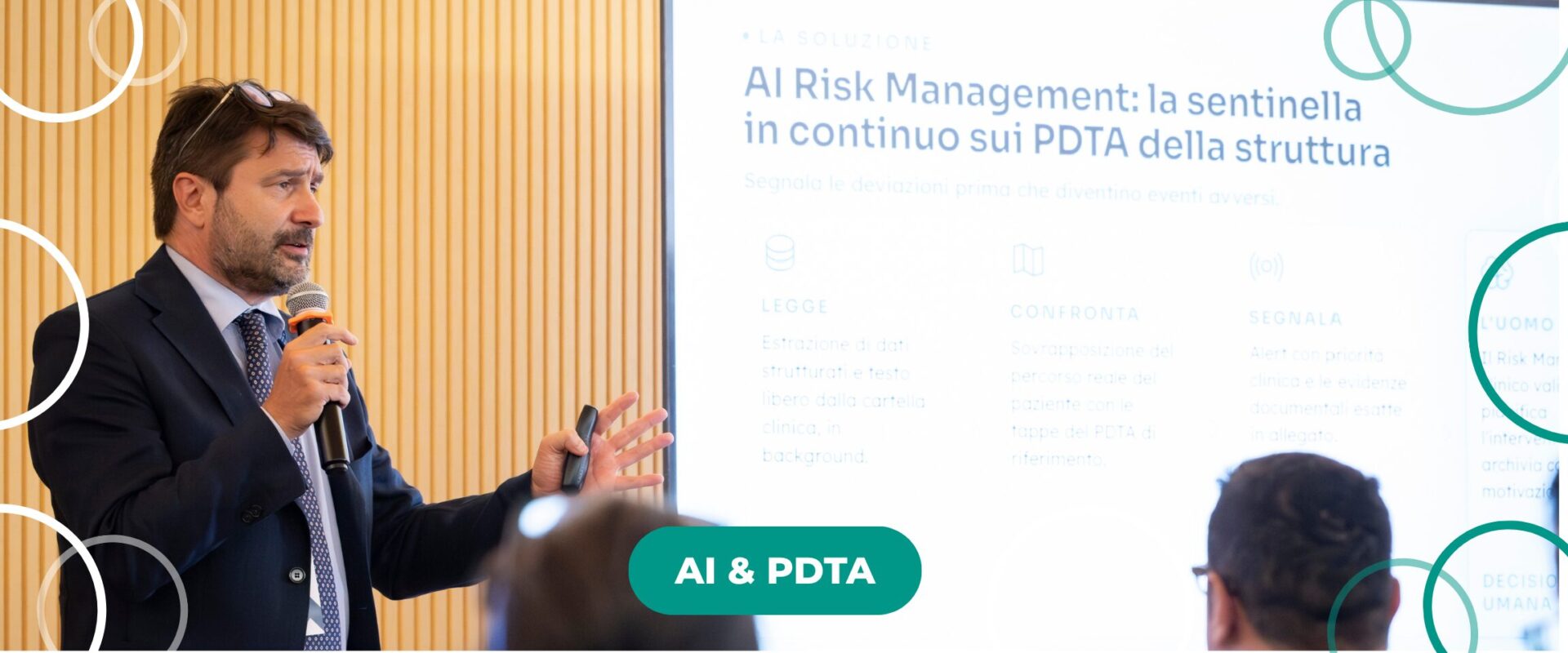
On Tuesday 7 July 2026, Giancarlo Stoppani, Founder and President of Connect Group, spoke at the AITO x Health event, presenting an in-depth perspective on the application of Artificial Intelligence to clinical risk management and the monitoring of Integrated Diagnostic, Therapeutic and Care Pathways, known in Italy as PDTA.
During his session, he exchanged perspectives with Dr Claudio Martini, Medical Director of the Azienda Ospedaliero Universitaria delle Marche, with whom he is currently working on a collaborative project that brings together clinical expertise, an in-depth understanding of hospital processes and technological innovation.
The project is based on a practical premise: much of the information required to identify and mitigate clinical risk is already available within healthcare information systems. The real challenge is to connect, interpret and present that information to professionals while there is still time to take preventive action.
Making risk signals visible
Clinical risk does not always result from a single, clearly identifiable error. It may develop gradually through a series of apparently isolated signals: a delayed test, an incomplete procedure, a treatment that has not been reassessed, information that has not been shared or a patient who has not completed the expected follow-up.
Healthcare organisations generate large volumes of data every day through electronic health records, clinical reports, prescriptions, treatment plans, appointments and professional notes. However, these data may be distributed across different applications, departments and stages of the patient journey.
Artificial Intelligence can support the continuous and coordinated analysis of this information, identifying connections and potential anomalies that may be difficult to detect through manual or retrospective review alone.
Using the PDTA as a monitoring framework
The model presented uses the PDTA as a map of the patient’s expected care pathway.
These pathways define the activities, checks, timelines and organisational stages required for the management of a specific clinical condition. By comparing the patient’s actual journey with the expected pathway, the system can identify deviations that may require further assessment.
Not every deviation is necessarily an error, as an individual patient’s condition may require personalised clinical decisions. However, a deviation that is not identified or reviewed in time may become a source of clinical risk.
AI supports; healthcare professionals decide
The role of technology remains clearly separate from the responsibility of healthcare professionals.
Artificial Intelligence analyses available information, connects data from different sources, compares the actual patient journey with the expected pathway and flags potentially relevant situations. The clinician, risk manager or designated professional interprets the clinical context, reviews the evidence and decides whether action is required.
AI reads and flags. People assess and decide.
The purpose is not to automate clinical judgement, but to extend the organisation’s capacity for observation and help professionals focus their expertise on priority cases.
A collaboration between healthcare and technology
The discussion between Giancarlo Stoppani and Claudio Martini highlighted the value of designing solutions around the reality of hospital practice.
Clinical and organisational expertise is essential to determine which deviations are genuinely significant and which information should be considered in the context of each patient. Technological innovation makes it possible to translate that knowledge into tools capable of continuously analysing a volume of data that could not be managed manually.
The ongoing collaboration aims to develop a more proactive approach to clinical risk management, turning information already available within healthcare systems into practical tools for prevention, traceability and decision support.
Turning data into prevention
The message shared at AITO x Health was clear: much of the information required to improve patient safety is already available within healthcare organisations.
The challenge is to make it visible and actionable while there is still time to intervene.
By combining human expertise with technological capability, Artificial Intelligence can support a more continuous, timely and integrated approach to clinical risk management, without replacing professional judgement or accountability.