According to the World Health Organization, in high-income countries, one in ten patients experiences an adverse event during hospitalization, and nearly 50% of these events are preventable.
Healthcare risk management is now widely recognized as a strategic driver of care quality. However, in practice, it remains largely reactive: it is triggered after a critical event occurs rather than preventing it.
This gap between theory and practice is where Connect positions its work, aiming to transform risk management into a continuous, operational process within healthcare organizations.
The limitation of traditional models does not lie in their ability to classify risks, but in their difficulty in detecting them early—before they materialize.
Limitations of traditional approaches
Established frameworks, such as those defined by ISO standards—particularly ISO 31000:2018—rely on tools like probability-impact matrices.
While essential for risk mapping, these tools are inherently static. They capture risk at a specific point in time but fail to reflect its evolution.
The role of weak signals
In recent years, attention has shifted toward a more complex but crucial element: so-called weak signals, meaning early indicators that precede critical events.
These often take the form of minor deviations—delays in procedures, departures from clinical guidelines, or organizational anomalies. Individually, they may appear negligible, but collectively they can signal emerging risk.
This topic has also been addressed internationally, for example by the Organisation for Economic Co-operation and Development in its report Mapping Emerging Critical Risks (2024), which highlights that waiting for consolidated evidence often means acting after the risk has already materialized.
From theory to operational practice
In healthcare, managing weak signals presents clear challenges: they are numerous, difficult to detect, and require sustained attention that cannot rely solely on human operators.
Additionally, guidelines, protocols, and procedures do exist—but they are not always accessible at the point of care when needed.
The issue is not the absence of rules, but their lack of integration into daily clinical workflows.
The Connect approach
The model developed by Connect introduces a shift in perspective: not replacing existing frameworks, but making them operational by intervening while risks are still latent.
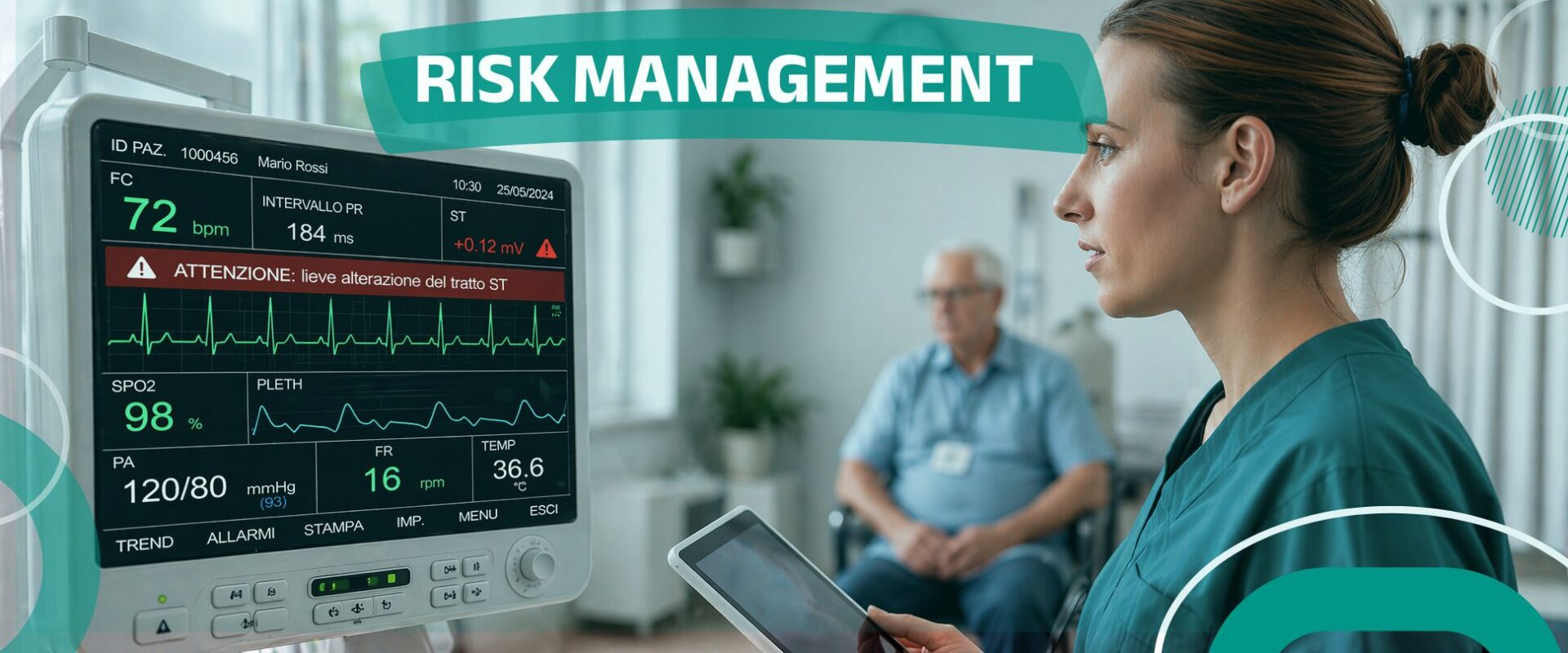
The system acts as a continuous monitoring layer over existing processes, detecting weak signals as they arise and alerting healthcare professionals within their specific workflow context.
Timely and contextual alerts
In practical terms, this means the system can highlight potentially critical situations as they occur.
Examples include prescriptions that are inconsistent with a patient’s condition or missed steps in established protocols.
In such cases, alerts enable immediate intervention, preventing escalation into more serious adverse events.
Supporting decision-making
The system does not replace clinical decision-making—it supports it.
Responsibility remains with the healthcare professional, who evaluates the alert and determines the appropriate course of action.
Integration with existing systems
A key strength of the Connect approach is its ability to integrate with existing healthcare IT systems.
Information is retrieved and presented within the operational workflow, without requiring changes in tools or working methods.
This ensures continuity while enhancing processes with advanced analytical capabilities.
Reducing complexity
One of the most relevant aspects is support for healthcare professionals.
Information overload, complex care pathways, and operational pressure make it difficult to maintain a comprehensive overview.
The system helps make this complexity manageable by highlighting what matters most, allowing clinicians to focus on decision-making rather than data retrieval and verification.
The role of technology
From a technological perspective, the system consists of independent intelligent modules, each designed to monitor specific conditions or rules.
This enables the simultaneous management of multiple scenarios and adaptation to different operational contexts without increasing user burden.
Toward an integrated quality model
Beyond technology, the cultural dimension remains central.
In many settings, risk management is still perceived as a formal or retrospective activity.
This approach is part of a broader shift toward embedding risk management into daily processes and strengthening its preventive role.
In this perspective, the boundary between quality of care and risk management becomes increasingly blurred.
The goal is not to eliminate risk, an impossible task in complex systems like healthcare, but to build systems capable of identifying it before harm occurs, transforming risk management from a formal requirement into everyday practice.