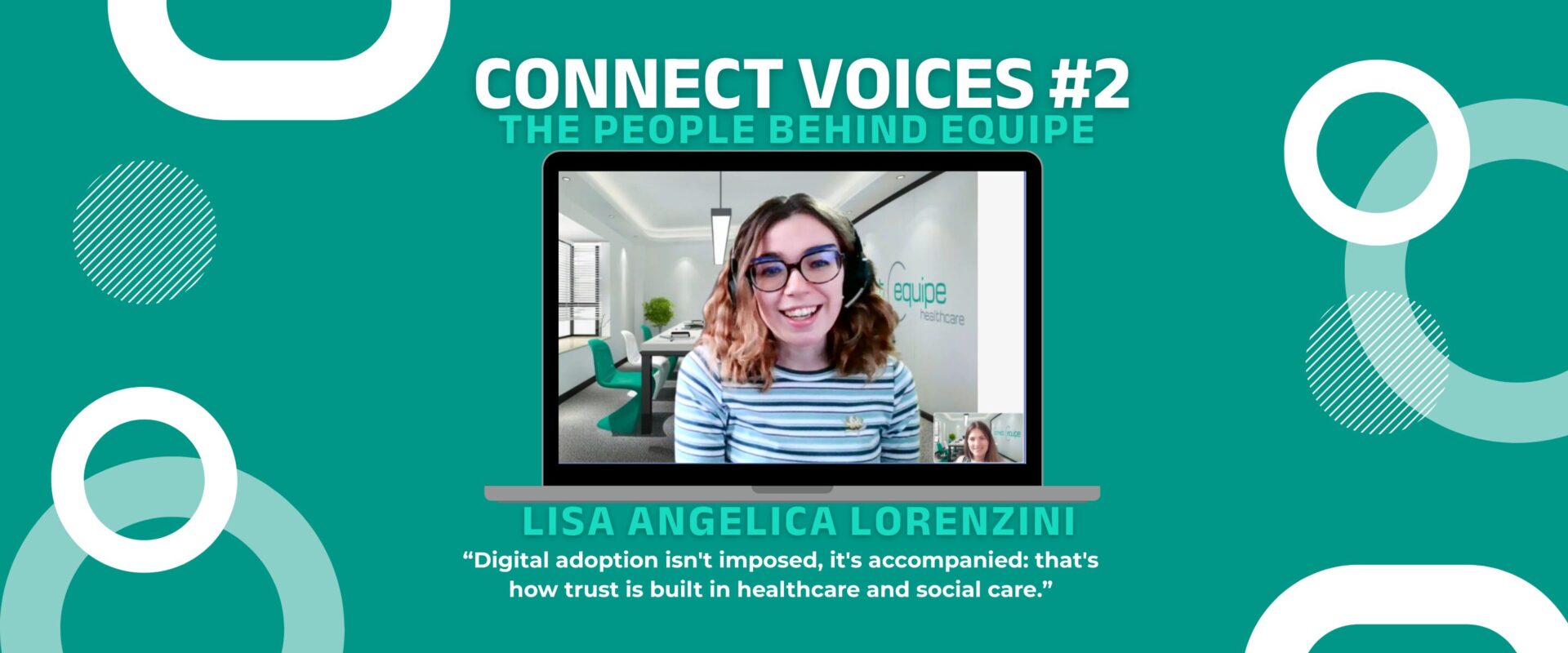
We don’t just install software. We accompany people until they trust it
In the digital transformation of the healthcare and social care sector, technology alone is not enough. Someone is needed who can translate the complexity of a product into the everyday reality of the people working on a hospital ward, in a residential facility, or in a care center.
That is the role of Lisa Angelica Lorenzini, the point of contact between the technical complexity of Connect Group and the real, day-to-day operations of its clients: healthcare directors, facility managers, clinical professionals who use equipe every day.
With her, in this second episode of Connect Voices – The People Behind Equipe, we explore how trust is built, how an organization is guided toward digital adoption, and what role artificial intelligence can truly play in the work of care.
From Nurse to Bridge Between Clinical Practice and Technology
Trained as a nurse, Lisa brings to her daily work at Connect a skill rarely found in the software world: the ability to genuinely recognize the world of the people who will use the platform.
“I still recognize the clinical and healthcare world — above all the language, the terminology, the pace of work, and the decisions professionals have to make.”
This direct, first-hand knowledge allows her to interpret requests more accurately, understand the real priorities, and propose solutions that make daily practice easier, instead of adding further complexity.
Listening as a Working Method
People working in social and healthcare settings are often under pressure, carrying enormous responsibility with very little time. For Lisa, the starting point is always the same: listening.
“I try to understand the context the person in front of me is working in, what problems they’re facing, what their real needs are.”
This approach lets her identify the true priority — which doesn’t always match the technical one — and propose solutions designed to reduce workload, not add to it.
Building Trust From the First Contact
When a new client reaches out to Connect, it is often at a difficult moment: a system that isn’t working, a stalled project, a complicated transition.
Lisa builds trust by starting with active listening, using accessible language even when the situation is technical, and making sure the person feels understood.
“I try to make it clear that the request has been taken on board. Sometimes I share examples of similar cases we’ve already handled, to say: you’re not alone, we’re able to deal with this.”
Demos That Speak the Language of Care
Even in demos, where the first contact tends to be colder, Lisa avoids simply listing technical features. She prepares each presentation around the client’s specific context, building concrete use cases and using the terminology the audience recognizes from their own daily work.
The goal is for the person to later be able to explain internally, in their own words, where and how the software becomes a real opportunity — not just another bundle of technical features.
Even when faced with tough questions or resistance, her approach stays the same: listen, never assume, and understand that behind an objection there may be a different problem — often an emotional one, like fear of change. From there, solutions are built together with the client, adapted thanks to the flexibility of the equipe platform.
Guiding Transformation, Step by Step
In the social and healthcare sector — often marked by limited resources, mixed teams, and a digital culture still taking shape — accompaniment makes all the difference.
For Lisa, this means being present at every phase of a project: initial analysis, listening to needs, defining shared goals, training, and ongoing support even after go-live.
“Installing software isn’t a click. It takes a gradual process, training, and constant support — especially afterward.”
Documentation as a Tool for Trust, Not an Obstacle
Documentation and compliance, often seen as bureaucratic burdens, become in Lisa’s account a genuine operational tool: user manuals, release notes designed for the end user, content built partly from client feedback itself.
“It’s the center of knowledge, both for us and for the people using the software.”
Complete, thorough, up-to-date documentation is also a form of protection — useful for the certifications that guarantee the product’s quality.
Artificial Intelligence: A Support, Not a Substitute
On artificial intelligence, increasingly present in healthcare and social care facilities, Lisa has a clear position: AI should be presented as added value, not a threat.
“It must not replace the professional’s expertise, nor the relationship with the patient.”
Its role is to free up time from repetitive, bureaucratic tasks, giving that time back to the quality of care and to critical thinking — which always remains human.
“On the other side, we have a machine. The thinking brain has to stay the professional’s.”
Two Stories That Make the Difference
Among the most meaningful moments of her experience, Lisa recalls two stories that capture what real accompaniment looks like.
The first is about a professional who, at the start, would literally walk away whenever she saw Lisa arrive with a tablet, fearing extra workload. With patience, gradual steps, and listening, that same person went on to use the software confidently, finishing her shift without losing time on paperwork.
The second is about a nurse who grew anxious during an emergency, convinced the system wasn’t keeping up with him. Through collaboration and his own suggestions, they discovered a simple issue, which was resolved and optimized together.
“These are the small moments that end up making the real difference in clinical practice.”
Why It’s Worth It, Every Day
Asked what makes her get up every morning with this goal in mind, Lisa has no doubts: contributing to healthcare innovation means being an engine of change in a sector where “we’ve always done it this way” is still common.
Giving professionals more advanced tools means improving the quality of care and making it more efficient and sustainable — from telemedicine to robotics in the operating room.
“I try to keep a positive outlook on the future of digital healthcare.”
Lisa Angelica Lorenzini’s story shows that behind every feature of the equipe platform lies daily work built on listening, patience, and human closeness — the real difference between software that gets installed and a tool that truly gets adopted.